



A common question in clinical practice is why dental implants are usually placed in adults rather than in younger patients who are still growing.
The answer relates to biology, to the development of the jawbones, and also to an important concept: a dental implant is not a natural tooth. It is a highly useful, safe and effective solution when properly indicated, but it remains a prosthetic device integrated into the bone.
Natural teeth, if properly cared for and regularly reviewed, can last a lifetime. Implants can also last many years, but this does not mean they are lifelong solutions. They also require maintenance, regular check-ups and appropriate conditions in order to function correctly.
Below, we present a series of reasons why dental implants should not be the first option for younger patients, explore their longevity, advantages and disadvantages, and finally review a real case and consider alternatives to implants.
1: An implant does not grow with the patient
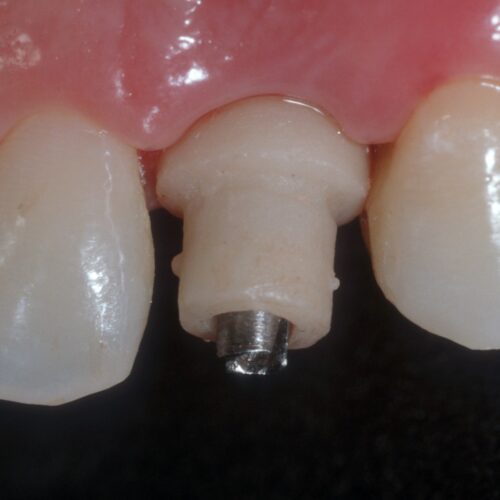
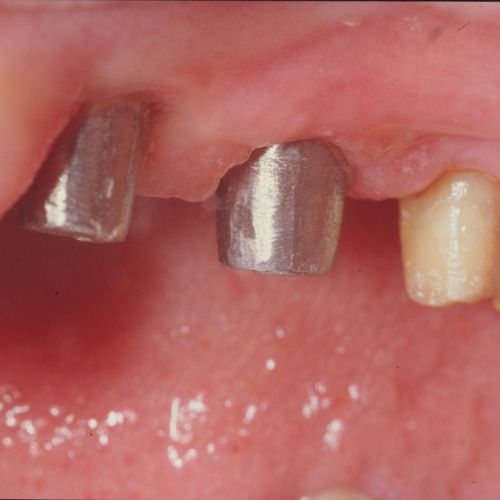
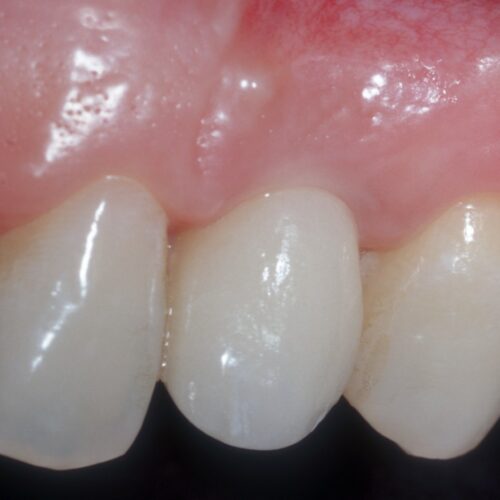
In children and adolescents, the bones of the face and jaw are still developing. Natural teeth adapt to this growth, but a dental implant does not behave in the same way.
Once placed in the bone, the implant remains fixed. For this reason, if it is placed too early, while the maxilla or mandible is still growing, it may eventually become misaligned with the rest of the teeth, or lead to aesthetic and functional problems. For this reason, chronological age alone is not sufficient; it is essential to assess whether bone growth has been completed.
“No dental implant is for life; that is impossible. No prosthesis in the human body—none at all—lasts forever, because it is not biologically part of us.”
Dr. Andrés Llobell
2: Dental implants have a history, but also limitations
Dental implants began to be used more widely decades ago, particularly in patients who had lost all their teeth and wore full dentures. In those cases, the oral environment was different: there were no adjacent natural teeth, and therefore the implant was exposed to fewer risk factors associated with neighbouring dentition.
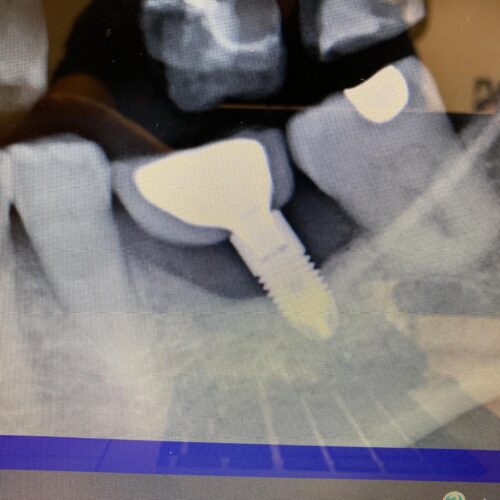
Over time, implants also began to be used to replace single teeth, i.e. to restore an individual missing tooth. This represented a major advancement, but also a more complex clinical scenario: the implant coexists with natural teeth, gingival tissues, bacteria, occlusal forces and potential periodontal issues.
For this reason, each case must be carefully assessed before deciding whether an implant is the most appropriate option.
“We began placing dental implants many years ago, from around 1985 onwards, initially in edentulous patients (patients with full dentures), where we did not encounter highly aggressive bacterial environments, and we placed prostheses without significant load on these implants. These are, without doubt, the longest-standing statistics.”
Dr. Andrés Llobell
3: A dental implant is not for life
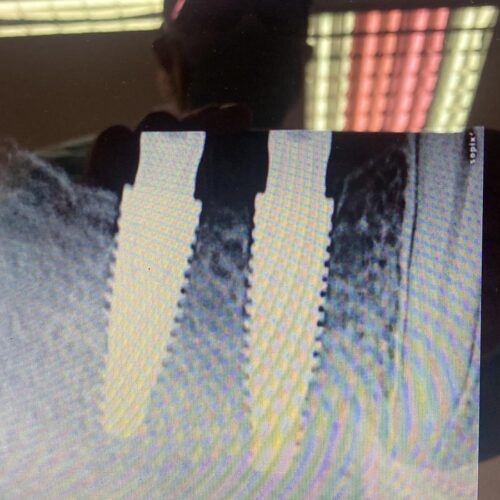
Although modern dental implants show high long-term survival rates, they do not last forever. Some reviews report a 10-year survival rate of approximately 93–96%, depending on the studies and methodology used.
While some implants may last longer, and there are cases of patients retaining them for decades, their long-term performance and survival depend on numerous factors: oral hygiene, bone quality, gingival health, the patient’s general health, smoking, the presence of periodontal disease, bruxism, and adherence to regular professional maintenance and follow-up.
“From around 1990 onwards, we began to place single-tooth implants, and from approximately 1995, immediate implants, extending treatments to patients who experienced difficulties chewing with their dentures.
In general, patients who retain their own natural teeth alongside an implant are exposed to a more aggressive bacterial environment, with bacteria present in the teeth adjacent to the implant, and therefore tend to experience reduced longevity.
There are important factors that can shorten the lifespan of implants: when the patient also has periodontal disease, when the patient has few remaining teeth, or when teeth are lost due to fractures caused by clenching or grinding.”
Dr. Andrés Llobell
4: Implants can experience bone loss
Bone loss can occur around a dental implant over time, particularly if inflammation, poor oral hygiene, excessive loading or peri-implant disease develops.
Peri-implantitis is an inflammatory condition affecting the tissues surrounding the implant and can lead to bone loss. Well-established risk factors include inadequate oral hygiene, smoking, a history of periodontitis, poorly controlled diabetes and a lack of regular maintenance.
This is why follow-up appointments are so important. Unlike natural teeth, an implant does not always produce pain in the early stages of a problem, and in many cases initial complications may go unnoticed by the patient.
“Do implants lose bone? Yes, and this is inherent to them. Even in the best-case scenarios, we observe a gradual loss of bone level over the years, which can also affect adjacent teeth. This is one of the reasons why their use should be reserved for adults.”
Dr. Andrés Llobell
5: Teeth should be preserved whenever possible
Today we know that when a natural tooth has a favourable prognosis, the ideal approach is to attempt to preserve it. Teeth are biological structures, with a periodontal ligament, sensitivity and a natural capacity to adapt within the oral environment.
This does not mean avoiding implants when they are needed; rather, it means using them only when they are truly the best option.
In many cases, before extracting a tooth and placing an implant, we assess whether it can be maintained through periodontal treatment, restorative dentistry, endodontics or fixed prosthodontics. If a conservative option is viable and offers a good prognosis, it is usually worth pursuing.
“From a professional standpoint, I consider that natural teeth should be used as abutments for fixed prostheses whenever possible, and that implant-supported prostheses should be considered when this first option is no longer viable.”
Dr. Andrés Llobell
When an implant is recommended
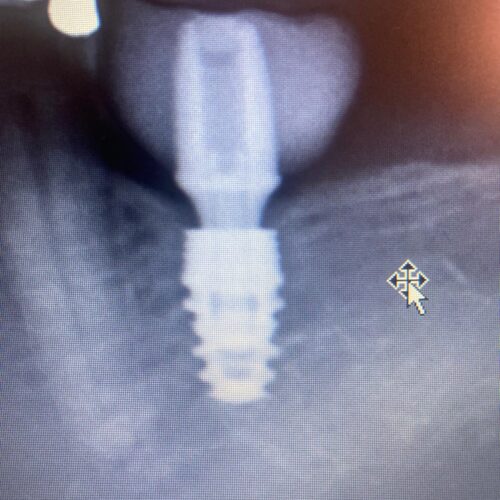
We consider implants when a tooth can no longer be preserved, when a tooth is missing, when a conventional prosthesis is not viable, or when there is a need to restore function, aesthetics and stability in a safe and predictable way.
They are also indicated in adult patients who have lost multiple teeth and require more comprehensive rehabilitation.
The key is not to rush the decision. An implant should be placed at the right time, with careful planning and a long-term perspective.
Dental implants are an excellent solution when correctly indicated. However, it is also true that we place great value on natural teeth. For this reason, before resorting to implants, it is advisable to do everything possible to maintain oral health: good at-home oral hygiene, regular check-ups, periodontal monitoring and early detection of any problems.
At Clínica Llobell, we recommend regular reviews to assess teeth, gums, bone and implants, in order to avoid unexpected issues. Prevention remains, above all, the best form of treatment.
““There is a line of clinical practice that uses shorter implants, with the aim of preserving sufficient bone for a potential second phase involving new implants in the future.”
Dr. Andrés Llobell
Conclusion: Dental implants should be a good solution, not an automatic decision
Dental implants have transformed dentistry and make it possible to replace missing teeth with very good outcomes. However, they are not a solution that should be used without careful consideration of the clinical context.
They are placed in adults because we need to ensure that bone growth has finished and because, in most cases, they are an alternative when a natural tooth can no longer be preserved.
Every patient, every mouth and every clinical history is different. For this reason, before making a decision, the most important step is to thoroughly assess the case and address all questions during the consultation.
Real case: young patient with multiple missing teeth – implants, yes or no?
To better understand this approach, we can look at a real case, although only an initial will be used to protect the patient’s privacy. We will refer to him as B.
B. attended Clínica Llobell at just 30 years of age. This is a very significant detail, as we are dealing with a young patient with many decades ahead of him, and with dental decisions that could have a lifelong impact.
He was missing several teeth, and other teeth were in very poor condition and required extraction. He had previously consulted other clinics and came with the understanding that his case could only be resolved through a very extensive implant-based rehabilitation, as this was what had been proposed to him: extracting multiple teeth, regenerating bone, placing several implants and then restoring the case with implant-supported crowns.
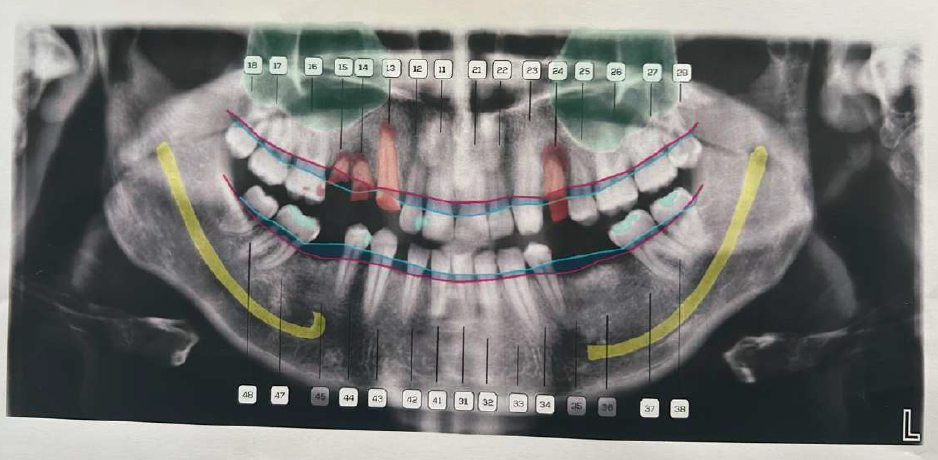
In one of the external treatment plans, a highly implant-focused approach was proposed, involving extractions, bone regeneration, guided surgery, implant-supported crowns and up to six dental implants, with a very high overall cost.
In another assessment, orthodontic treatment was also suggested prior to the implant phase. This would have extended the overall treatment time, increased the cost and subjected the patient to a more complex process before even reaching the final rehabilitation.
However, in a 30-year-old patient, the question cannot simply be: “how many implants are missing?”. The question must be much broader: which teeth can be preserved, which structures are still functional, and how can we plan a dentition with a long-term future?
That distinction completely changes the clinical approach.
In B.’s mouth, not everything was lost. There were edentulous areas, missing teeth and compromised teeth, but also teeth that could still provide functional value if the rehabilitation was properly planned. For this reason, instead of proposing a predominantly implant-based solution, Clínica Llobell considered a more conservative alternative: restoring different areas with porcelain fixed prostheses, using natural teeth as abutments wherever possible.
The proposed plan included several fixed restorations: a three-unit bridge in the upper left quadrant, a four-unit bridge in the lower left quadrant, and another three-unit bridge in the lower right quadrant. For the upper right quadrant, two options were considered: either a solution with two implants supporting three crowns, or a six-unit porcelain fixed bridge, depending on the final assessment of available support.
In other words, the case was not approached from the idea of “replacing every missing tooth with an implant”, but from a global view of the mouth. In some cases, a well-designed bridge can replace a missing tooth without the need to place implants in every gap. When correctly indicated, this allows more tooth structure to be preserved, simplifies treatment and keeps future options open.
The truly important point was to avoid overtreatment with implants in a very young patient. Placing multiple implants at 30 is not the same as placing them at 70. At 30, those implants will need to function for decades alongside changes in bone, gingival tissues, occlusal forces, oral hygiene challenges, wear and potential future treatments.
An implant is an excellent tool when indicated, but it is not a tooth. It has no periodontal ligament, it does not behave like a natural tooth, and over time it can influence the available bone and future treatment options.
For this reason, when we can maintain natural teeth with a good prognosis and use them safely, that is often the more prudent option. Not because implants are inadequate, but because they should be reserved for when they truly add value.
This case summarises our philosophy very clearly: it is not about placing fewer implants as a rule, nor more implants as routine. It is about placing the right ones, at the right time, with the patient’s long-term future in mind.
At Clínica Llobell, we believe that a good rehabilitation is not always the most complex one, but the most appropriate one for each case. And in B.’s situation, the best solution was not to begin with a mouth full of implants, but to preserve, plan and rehabilitate with clinical judgement.